

The Blind Spot in Promotion Tracking: Why Flyer and Receipt Data Alone Are No Longer Enough for FMCG Brands
Flyer monitoring shows what everyone sees. Receipt and scanner data show what was bought. What happens in between, namely which coupon in which app was shown to whom and activated by whom, remains invisible to most brands. Yet this is exactly where a growing share of promotion impact is decided.
Anyone who plans or evaluates promotions in FMCG usually works with two proven sources. Flyer monitoring shows which promotions retailers advertise publicly: week, price, placement. Receipt, household panel or scanner data show what ended up in the shopping basket. For a long time, that was enough, because the promotion itself was public. An offer in the flyer applied to everyone.
That has changed in recent years. A growing share of discounts no longer runs through flyers and shelves, but through retailers' apps: Lidl Plus, Mein dm, Rossmann, REWE, PENNY, Kaufland, Netto, EDEKA. There, you find coupons that only part of the customer base sees, promotions that apply only in the app, spend-and-save schemes and loyalty programs, sweepstakes with brand partners and, increasingly, personalized offers. This relevant area is precisely what is not publicly visible.
Classic data sources miss this layer. The retailer knows it; manufacturers usually don't.
Apps Have Become the Promotion Control Center#
Three developments make the topic more urgent than it was two years ago:
1. The reach is there. For many people, retailer apps are now as much a part of shopping as the shopping list. The Rossmann app alone reaches more than 10 million users a month. Anyone who pays or collects points with the app in store automatically gets the app coupons as well.
2. A large share of coupons is for branded products. In our analysis of more than 27,000 coupons from eight retailer and drugstore apps, just under half of all coupons in Food & Beverages were for branded products, and in Beauty as many as 74%. The app is therefore not just a channel for private labels, but a place where manufacturer budgets are invested. But how is the success of this investment measured independently? And how do you keep an eye on the competition?
3. Personalization is increasing. In the first quarter of 2025, the share of coupons seen by fewer than 1% of app users rose by almost 10% in grocery apps. The more personalized the offers, the less the promotional landscape can be pieced together from the outside via a flyer or a sample of screenshots. Every person gets different content in their app.
How App Coupon Data Helps FMCG Brands#
Over the past two years, we have worked on exactly this gap with manufacturers from food, confectionery, beverages, laundry and cleaning products, and personal care, together with teams from shopper marketing, market insights, key account management and category management. Ultimately, it almost always comes down to these four questions:
Where is my brand visible in the apps, and where is it not? We show every coupon and every app offer in a category, across all major retailer apps, with brand, discount level and reach. In the dairy, cheese and butter segment alone, that came to around 3,400 coupons and offers from more than 400 brands in seven apps in July and August 2026. Nobody can keep track of that manually.
Which mechanics do competitors and private labels use? A broad discount for everyone or a personalized coupon with small reach? Percentage off or multiplied points? The retailers differ greatly here. Anyone who looks at only one retailer app can quickly draw the wrong conclusions.
How does my coupon compare? What matters is not just who sees a coupon, but who activates it. In January 2026, 54 to 56% of Mein dm app users saw the brand coupons with the highest reach, and around a third activated them. The general 10% discount on the total purchase reached an activation rate of 86%. Differences like these are not visible in any flyer.
What do I bring to the annual negotiations with the retailer? For joint promotions, such as a sweepstakes in Lidl Plus, the KPIs usually come from the retailer itself. We provide independent data that allows comparison with your own promotions and those of competitors, including across other apps. This puts past investments in a new light and helps plan the next budgets.
All of this is delivered not as yet another dashboard, but as a ready-made answer: an insights report per category, plus an Excel file with all coupons in the period for your own analyses.
Measured in Everyday Life, Not Surveyed#
Depending on the retailer app, 500 to 1,000 real users are available. They have voluntarily installed a measurement app that captures what actually appears on screen in the retailer apps. This makes every promotion visible, including app-exclusive and personalized coupons, exactly as they are delivered and used in everyday life: which coupon was shown to whom and who activated it. Because participants also record their receipts, the chain can be followed all the way to the purchase. All analyses can be filtered by target group, the measurement is GDPR-compliant, and the data is stored on servers in Germany.
Use this unique data source to explore app coupons across all major retailer apps.
Conclusion#
Flyers and receipts remain important building blocks of promotion tracking. But they were built for a world in which promotions were the same for everyone. With the shift into retailer apps and growing personalization, a gap is opening up between what is publicly advertised and what is ultimately bought. A growing share of manufacturer budgets lies in this gap.
Want to see what this looks like for your category? We will gladly put together a sample extract with all coupons in your segment across the major retailer apps, including reach and activation rate per coupon. Write to us at info@murmuras.com.
Ready to unlock consumer insights?
See what real-world mobile behavior data can reveal for your business questions.
About the author
Qais Kasem
Related Posts
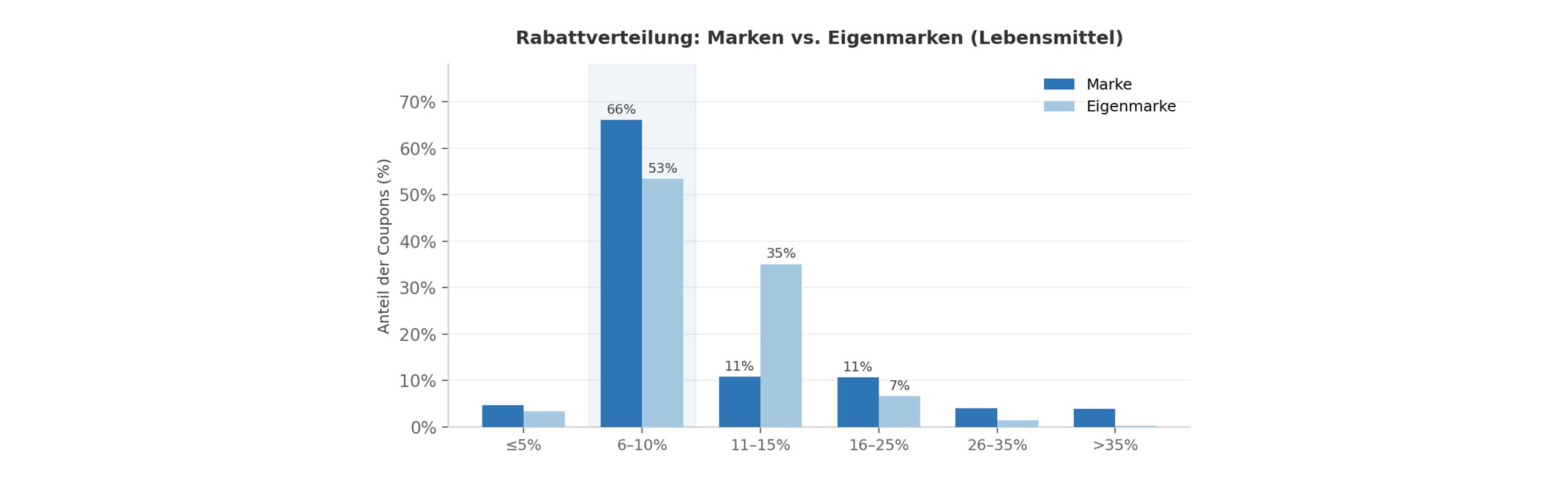
Couponing in Retail Apps: Where FMCG Brands Give Away Visibility
Every second coupon in German retail apps promotes a branded product – yet private labels and generic offers dominate the picture. A Murmuras analysis of over 27,000 coupons across eight retail and drugstore apps reveals where FMCG brands give away visibility and the three levers they can pull to win it back.
The App Revolution: Personalized Offers in Retail
The use of retail apps like Mein dm or Lidl Plus is growing rapidly – and with it the personalization of coupons. Murmuras has used new on-screen technology to investigate how personalized app offers really are and how successfully they are redeemed. The combination of app tracking and receipt matching provides a complete picture for the first time.
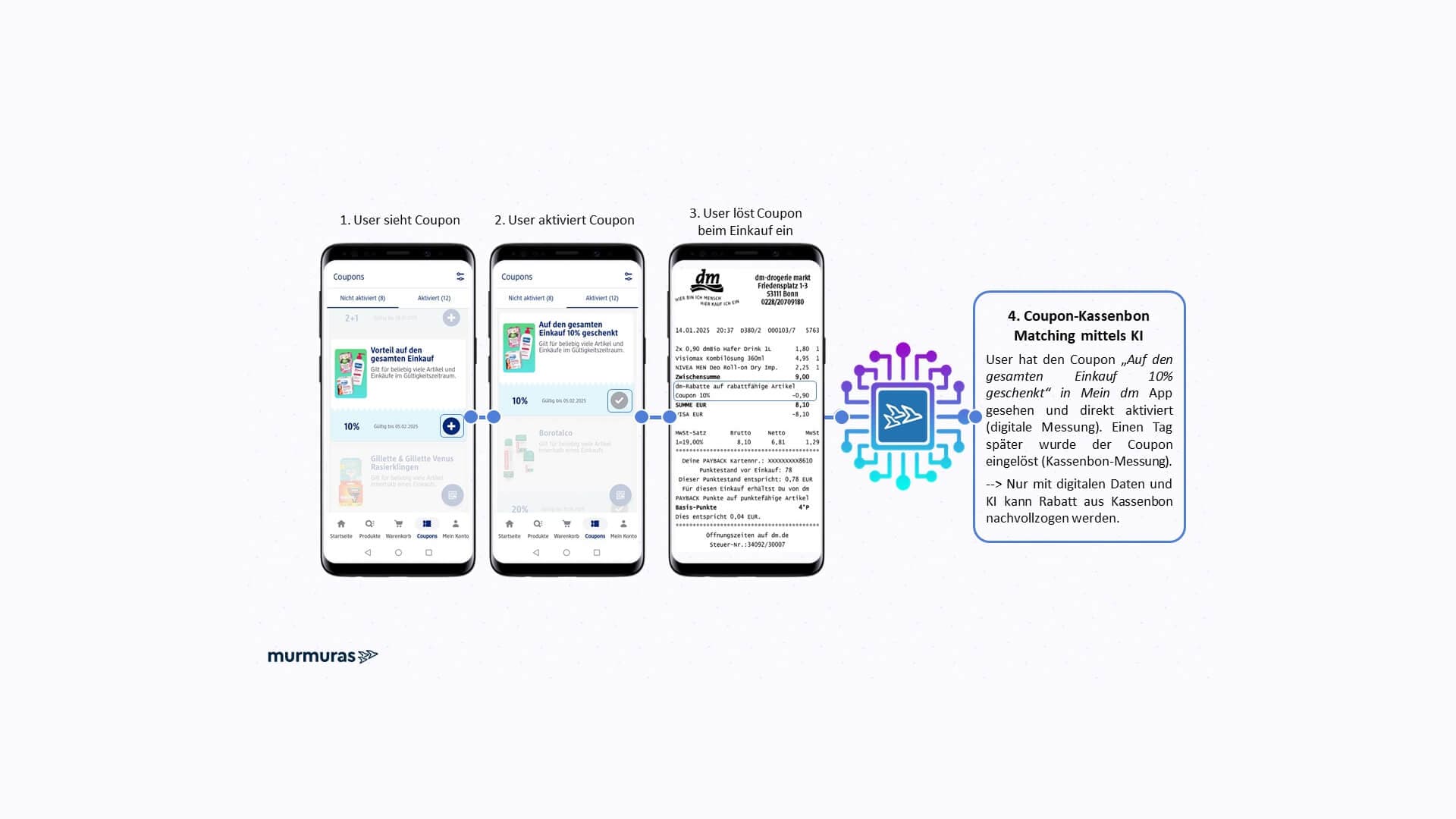
Murmuras' new consumer panel provides insights into retail app discounts
An increasing number of retailers are relying on exclusive app-based offers and personalized coupons. A new consumer panel with 3,000 participants provides innovative opportunities for generating insights. The collected data offers valuable insights for retailers and manufacturers, helping to better understand customer behavior, assess the impact of discounts and develop more targeted strategies.