
Couponing in Retail Apps: Where FMCG Brands Give Away Visibility
Every second coupon in German retail apps promotes a branded product. Yet private labels and generic offers dominate the picture. A Murmuras data analysis of more than 27,000 coupons reveals where FMCG brands give away visibility – and how they can change that.#
Coupons in retail and drugstore apps have long been part of everyday life – for consumers and retailers alike. More and more users rely on them to search for deals. The Rossmann app, for example, records over 10 million active users per month1, and the Payback app a total of over 18 million active users2. The coupon section is among the most-used app features. But while retailers can analyze the performance of their campaigns in detail, FMCG brands have so far lacked a view of the bigger picture: How many coupons actually go to my brand? Where do I stand compared to private labels? And how personalized are my offers really being delivered?
A recent Murmuras analysis, based on more than 27,000 different coupons tracked among users across eight major retail and drugstore apps, provides robust answers3 for the first time. The results reveal a paradox: branded coupons make up half of all coupons – and yet, for the individual consumer, they are often less visible than private labels or generic offers (e.g. "10% off all baked goods" or "5% off the entire purchase").
The Visibility Problem: Many Brands, Little Presence#
In the largest segment, "Food & Beverages," which accounts for three quarters of all coupons, the pattern is most pronounced. While just under half of all coupons go to branded products, this volume is spread across hundreds of different brands. The result: top brands like Dr. Oetker or Ferrero reach a good 200 coupons – while the strongest private labels such as REWE Beste Wahl or Gut&Günstig each deliver over 650 coupons. On top of that come nearly 4,800 generic offers with no brand assignment, which further shape the feed.
Individual brands are therefore present in the coupon feed, but barely visible to consumers.
In the beauty segment, the situation is different: here, 74% of all coupons go to branded products. NIVEA leads clearly with 120 coupons, followed by L'Oréal and Gillette. The strongest private labels such as Cien or Balea follow close behind. Brands shape the coupon landscape more strongly here by comparison.
Discount Levels: Brands and Private Labels Compete#
About half of all coupons in the food segment are delivered as percentage discounts. A striking pattern emerges here: two thirds of all branded coupons grant a reduction of 6 to 10 percent – exactly the range in which private labels are also particularly active. Over 50% of private-label coupons fall into the same discount tier. Brands and private labels therefore compete not only side by side on the shelf, but also in the coupon feed – and at the same price level.
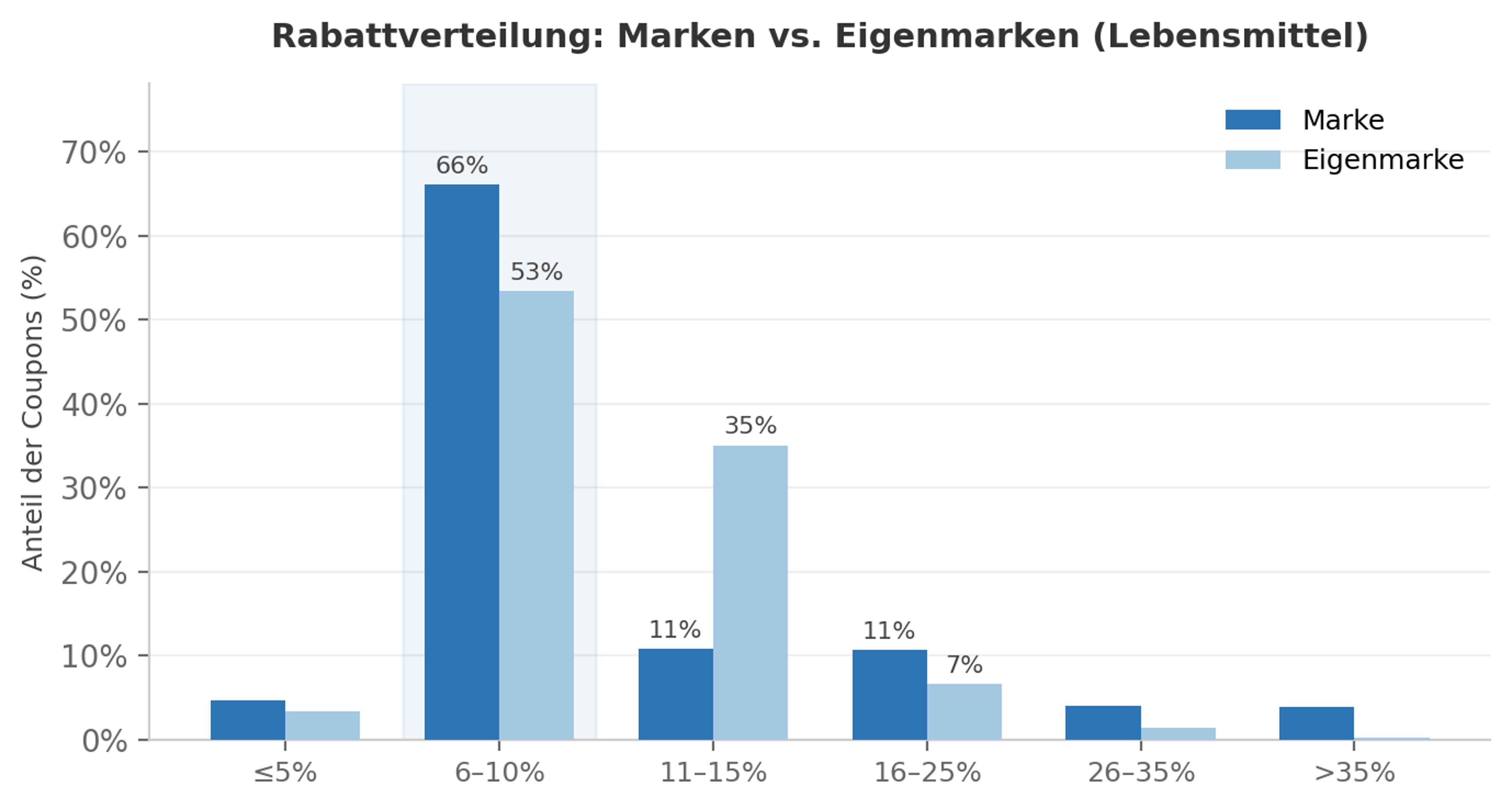
Base: 10,330 percentage-discount coupons in the Food / Beverages segment (brand: n = 3,068 | private label: n = 3,066 | generic: n = 4,196)
There is one difference, however: brands are the only ones that regularly offer significantly higher discounts as well. Around 8% of all branded coupons give at least 26% off – for private labels, it is just 1%. Anyone who wants to differentiate through discount level must therefore be either considerably more generous – or rely on smarter targeting.
A similar picture emerges in the beauty segment: 80% of all branded coupons here give 16 to 25% off. Almost half of the – albeit far less numerous – private-label coupons also fall within the same range. Brands therefore cannot set themselves apart particularly well through discount level here.
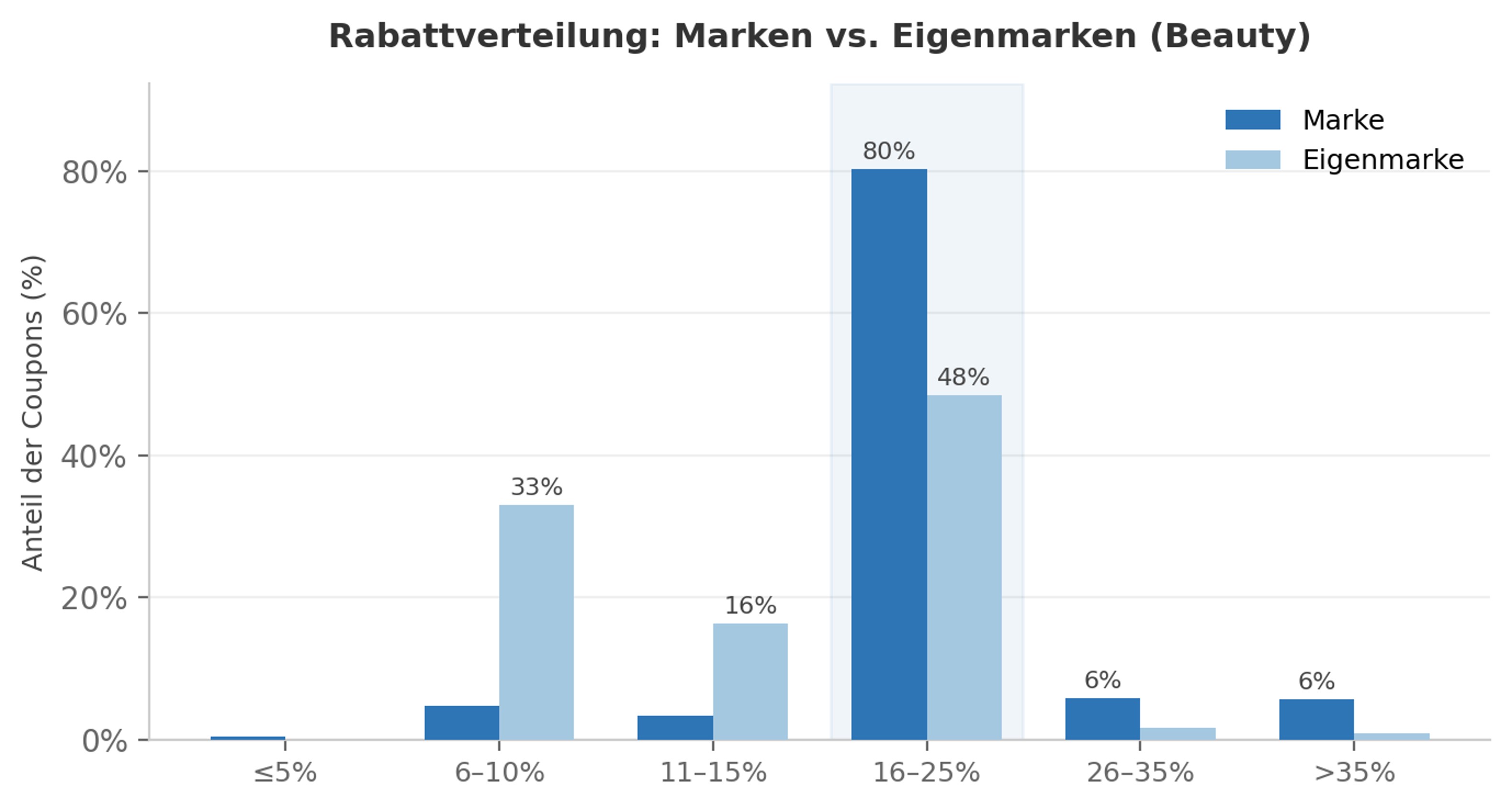
Base: 1,482 percentage-discount coupons in the Beauty / Personal Care segment (brand: n = 1,007 | private label: n = 246 | generic: n = 229)
The Underestimated Lever: Personalization#
Alongside visibility and discount level, a third factor determines whether a coupon works: personalization.
FMCG brands benefit in selected grocery apps such as REWE Bonus or Netto Plus, where branded coupons are delivered in a targeted way: the majority of all coupons are shown only to a very small group of users. This is where major opportunities lie for brands to be noticed by the right audience – when delivery is targeted and tailored to individual buyer profiles.
Conclusion: Three Questions Every Brand Should Ask#
Couponing in retail apps is not a niche topic for FMCG brands, but a central building block for visibility at the digital point of sale. Yet there is a gap between the strategic importance of branded coupons and their actual impact. The analysis points to three levers:
Check visibility: How many coupons does my brand deliver compared to private labels and competitor brands per app? Is the volume enough to be noticed in the coupon feed at all?
Question the discount strategy: Is my discount level in the same range as that of private labels and competitor brands? If so: do I differentiate through amount, frequency, or targeting?
Negotiate personalization: How well personalized are my coupons actually delivered – and are there ways to agree on more targeted delivery models with the retailer?
Those who can answer these questions have the foundation not just to spend coupon budgets, but to spend them effectively.
Sources and notes#
ROSSMANN press office: „ROSSMANN-App erreicht nächsten Meilenstein: 10 Millionen aktive monatliche Nutzer", at:
https://unternehmen.rossmann.de/presse/pressemeldung/rossmann-app-erreicht-meilenstein-10-millionen-aktive-monatliche-nutzer.html
(accessed 16 March 2026). ↩
PAYBACK GROUP: „Payback Daten und Fakten", at:
https://www.payback.group/de/group/payback/daten-und-fakten
(accessed 16 March 2026). ↩
About the data: Analysis based on real app-usage data from Murmuras (period: April–September 2025; 1,183 participants; apps: REWE, Edeka, Penny, Lidl Plus, Netto Plus, Rossmann, Mein dm, Müller; 27,245 different coupons). Data is collected GDPR-compliantly from real screen recordings of participating users. ↩
Ready to unlock consumer insights?
See what real-world mobile behavior data can reveal for your business questions.
About the author
Kirsti Brandes
Related Posts
The App Revolution: Personalized Offers in Retail
The use of retail apps like Mein dm or Lidl Plus is growing rapidly – and with it the personalization of coupons. Murmuras has used new on-screen technology to investigate how personalized app offers really are and how successfully they are redeemed. The combination of app tracking and receipt matching provides a complete picture for the first time.
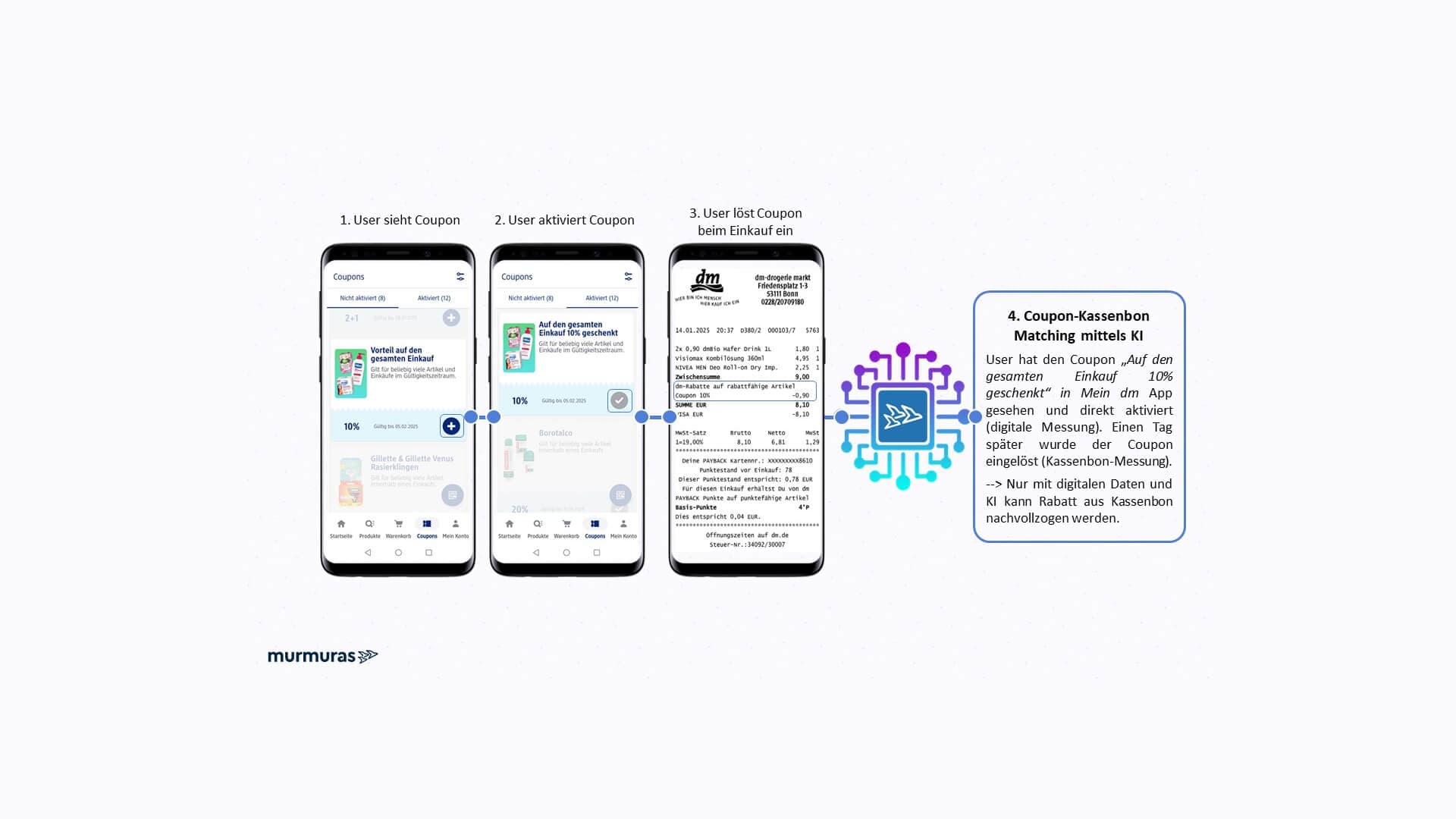
Murmuras' new consumer panel provides insights into retail app discounts
An increasing number of retailers are relying on exclusive app-based offers and personalized coupons. A new consumer panel with 3,000 participants provides innovative opportunities for generating insights. The collected data offers valuable insights for retailers and manufacturers, helping to better understand customer behavior, assess the impact of discounts and develop more targeted strategies.
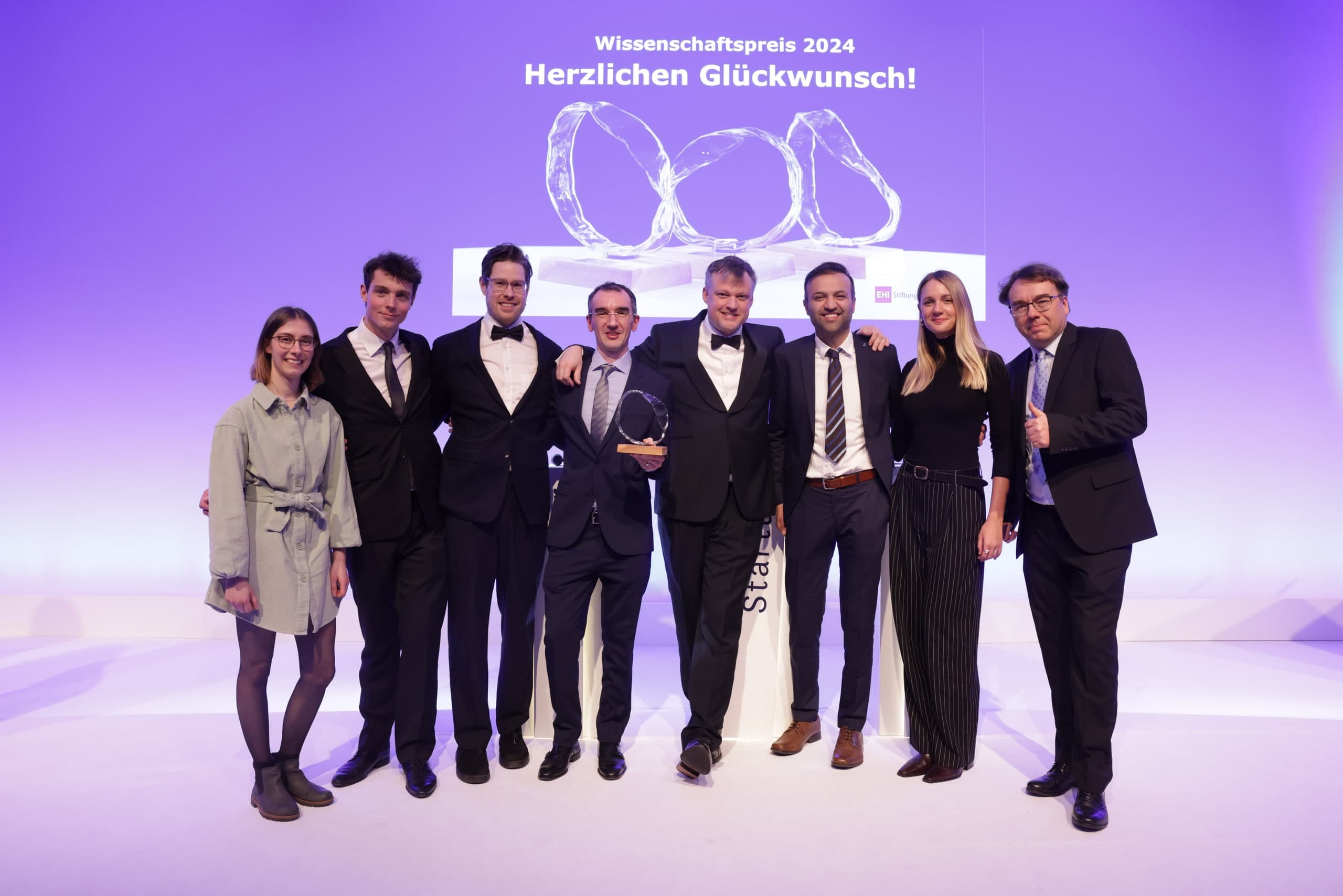
Murmuras is honored with the 2024 Science Award
Murmuras won the 17th Science Award for Best Startup with their innovative platform for analyzing Retail Apps and mobile consumer behavior. Founded in 2019 at the University of Bonn, the company has evolved from a technology provider in academia to an analysis firm specializing in Retail Apps.