
Seen Ads in ChatGPT Yet? How OpenAI Advertises in Everyday Life in Germany
This article was first published in German on September 30, 2026, on marktforschung.de.
Since August 24, 2026, OpenAI has also been serving ads in Germany. We have been measuring these ads since day one on the smartphones of more than 600 ChatGPT users who have consented to tracking, together with the conversations that immediately precede them. After one month, a picture is emerging: there are surprisingly few ads, they come from surprisingly small advertisers, and they match the ongoing chat surprisingly often.
The Launch: Ads in ChatGPT from August 24, 2026#
OpenAI first tested ads in the US in February 2026 and extended them to 31 European markets on August 24, Germany included. The free version and the Go plan are affected; Plus, Pro and Enterprise remain ad-free.
In our panel data, the first ads appear at noticeable scale on August 27. Before that, there are only isolated (test) cases. The analysis in this article therefore covers a full month, from August 27 to September 27, 2026: 621 active ChatGPT users, 2,259 ad exposures, 1,118 different advertisers.
Very Few Ads Are Being Served So Far#
41.2 percent of ChatGPT users in the panel saw an ad at all over the course of the month. Ads appear on 17.7 percent of ChatGPT usage days. A typical ChatGPT usage day thus contains zero to one ad. Social media is a different world:

Figure 1: Ads per active usage day. Murmuras panel, August 27 to September 27, 2026. Counts distinct ads per day and person, not screen views. The mean is pushed up by a few heavy users; the median describes the typical day.
The gap is one to two orders of magnitude. That looks deliberately dosed: an AI assistant that you ask questions evidently tolerates less ad load than a feed you scroll through. And OpenAI is unlikely to want to annoy its own user base early on.
That said, ad load is picking up noticeably. In the first week after launch, there were 0.12 ad exposures per usage day; by the fourth week, there were 0.62. Over the same period, the share of users who see at least one ad within a week rose from 17 to 42 percent. For advertisers, this means reach is not yet a selling point here; the space is still almost empty. Who is already using it, however, is surprising.

Figure 2: Ad exposures per usage day and weekly reach. Murmuras panel, August 27 to September 23, 2026. Base: 621 active ChatGPT users, 5,616 usage days, 2,259 ad exposures.
Many Small Brands, Few Big Ones#
1,118 advertisers for 2,259 ad exposures, an average of two exposures per advertiser across the entire panel. The largest single player is CHECK24 with 7.0 percent of all exposures, spread across all business areas of the comparison portal, from package holidays, hotels and car rentals to electricity and mobile plans. It is followed by a handful of well-known brands:

Figure 3: Largest advertisers in ChatGPT. Murmuras panel, August 27 to September 27, 2026. Base: 2,259 ad exposures among 256 ChatGPT users who saw ads. Ads have only been running in Germany for a month, so the ranking is preliminary.
More interesting than this top tier, however, is what lies beneath it. 941 of the 1,118 advertisers have at most two exposures across the entire panel, and many of them are the last thing you would expect in a national advertising environment:
- “House and apartment clearance in Basel”, a clearance company offering free on-site viewings and fixed prices
- “facial in hannover for skin that can breathe”, a beauty salon in Hanover's Südstadt district
- “Poetry slam for your event”, an artist agency
- “Low-growing hedges: a wide selection from the pros”, a tree nursery
- “Plan and request wooden chairs for restaurants, cafés and hotels”, a hospitality furniture supplier
- “Custom software development from Vienna”, one of dozens of B2B software firms and digital agencies
Just under seven percent of the ad creatives are in English. This is therefore not a classic brand environment, but an open self-serve marketplace in its early phase, where trades businesses and sole traders run alongside CHECK24 and Henkel.
The punchline comes from an ad itself: the panel captured a creative in which an agency uses ChatGPT to advertise booking ads in ChatGPT. A second one asks: “Does ChatGPT know your company?”
The Targeting Is Better Than You Might Expect#
This is where our real angle lies: because we measure conversations and ads under the same user ID, we can reconstruct for every ad what the person was discussing with the AI immediately beforehand.
We manually reviewed 40 randomly drawn cases, each consisting of the ad plus the chat history before and after it. Result: 22 cases with a clear topical connection, 13 with a partial topical connection (the industry matches, the specific request does not), and 5 cases with no discernible connection. In nine out of ten cases, there is at least a topical bridge to the ongoing conversation. Some examples:
- “Can one person carry six jumbo packs of Babylove diapers alone?” leads to an ad for baby spring cradles, “for parents whose baby refuses to be put down”.
- “Oktoberfest in Mannheim, I've booked a table for 10 people” leads to a dirndl with an apron.
- “Hamburg to Dubai in business class with Miles & More miles” leads to an offer for airport parking in Hamburg, shuttle included.
- A development engineer asks whether AI is a threat to his job and inquires about ABB as an employer. Next comes an ad for a further-training program at the ABB Technikerschule.
- A question about charging stations with Type 2 connectors is followed nine minutes later by the Ford Puma Gen-E with an EV subsidy.
- “85 sqm terraced house without flooring, how much would vinyl flooring cost?” leads to a product card for self-adhesive oak vinyl at €58.50.
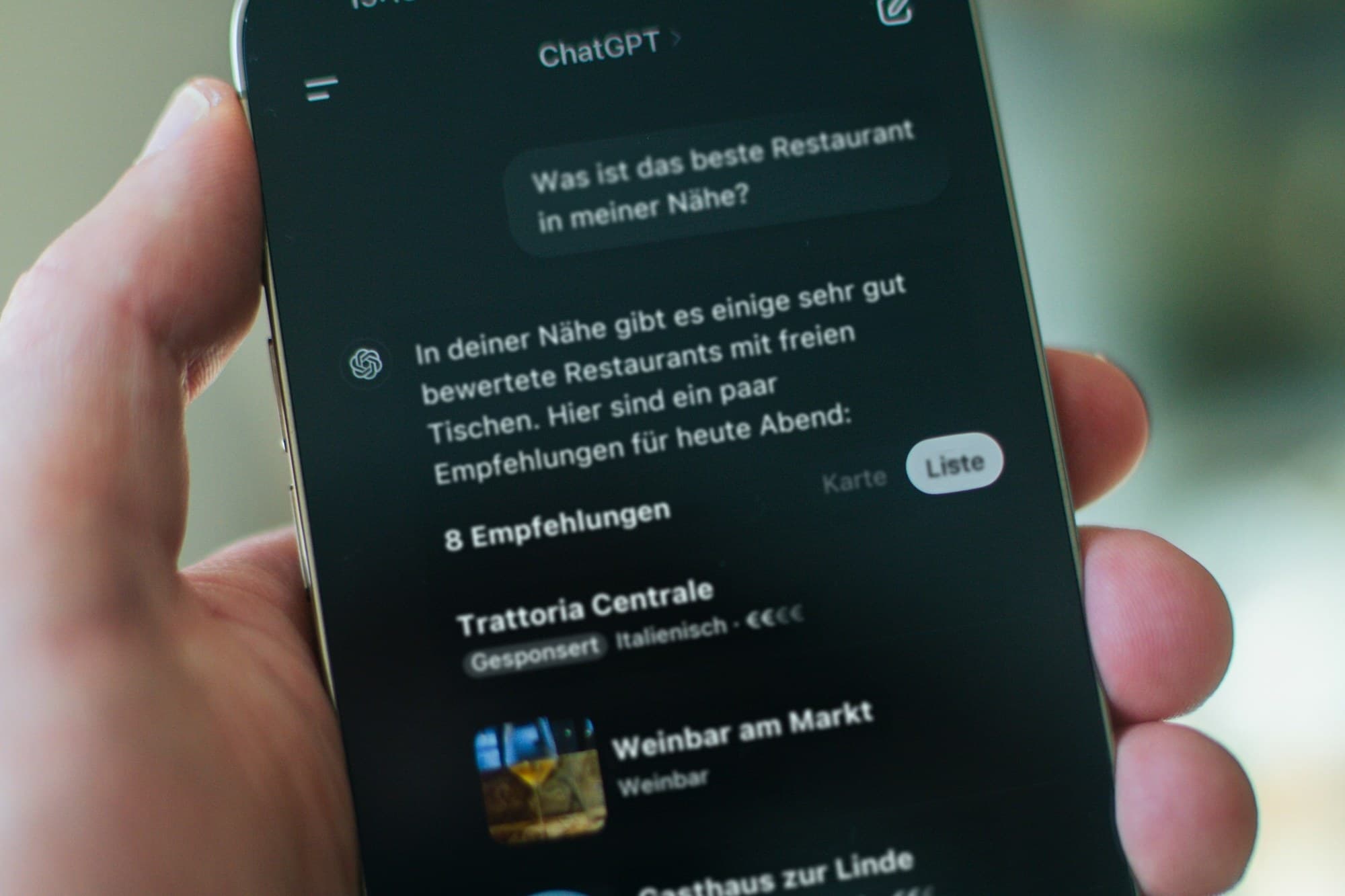
This is what it looks like on the device. A question about the price of a pack of diapers is followed, below the answer, by a text ad from Henkel for Persil Discs, with a note underneath stating that ads do not influence ChatGPT's answers. The same pattern shows up in the panel: Persil ads appeared there after questions about washing machines, laundry, robot vacuums and bathroom cleaning, consistently in a household context.

Figure 4: Text ad labeled “Anzeige” (German for “ad”), embedded below the ChatGPT answer, with an ad disclosure. Screenshot, September 2026. The conversation shown is not from the panel and illustrates the ad format.
Sponsored Product Suggestions Are the Real Lever#
In addition to the text ad below the answer, ChatGPT serves a second format: sponsored product suggestions, labeled “Sponsored” in the interface. These are product cards with an image, title and price, embedded in the answer. They appear almost exclusively in response to specific purchase research and, in our measurement, match the conversation topic two and a half times as often as text ads. The format is still rare: 81 of the 2,259 ad exposures fall into it.
This is where the real shift lies. People already ask AI assistants for product recommendations: in an earlier analysis of our panel, the AI actively recommended products in 19 percent of all conversations, usually because the user had asked for them. A recommendation that comes from a seemingly neutral answer has a different effect than an ad banner. If paid product suggestions appear right next to it in the future, companies gain a lever in a place where no ad space has existed so far.
Another finding fits this picture. On days when someone expresses purchase intent in the chat, for example by asking about prices, deals or a comparison, that person sees ads almost twice as often as on days without such signals: 30.3 versus 16.9 percent. This is not only because such days are more active overall. If you compare only days with a similar number of questions, the difference remains. Ads in ChatGPT therefore respond to expressed intent, which makes them work more like a search engine than a social feed.
What Comes Next#
The obvious question, whether an ad in the chat ultimately leads to a purchase, cannot be answered reliably after one month and 2,259 ad exposures. But it can be measured: in the same panel, we capture visited websites, app usage, digital purchases and, via photographed paper receipts, real purchases at item level, all under the same user ID. As soon as the case numbers are large enough, the chain from the question through the ad to the line item on the receipt can be traced end to end.
The reverse direction is just as interesting: which target groups talk to the AI about what in the first place. For ad exposure alone, we have so far seen hardly any socio-demographic differences; ad delivery follows the conversation, not the profile. The conversation topics themselves are a different story.
We are analyzing the data on an ongoing basis and will report back with updates in mid-November and early January: how ad load develops, which industries join, and whether the exposures turn into measurable purchases.
Methodology#
Murmuras operates a consent-based smartphone panel with around 3,000 participants in Germany (recruited via Bilendi, Horizoom and Trend Research). It captures what actually appears on the screen, not the platform's auction or targeting log. An ad exposure is defined as day × user × advertiser × creative, so scrolling past the same ad several times is not counted twice. The social media comparison values come from the same panel and period and are deduplicated using the same rule. The base is all panel users of the respective app, without socio-demographic filters; restricting it to participants with socio-demographic data on file leaves the medians unchanged and shifts the means slightly (Facebook 15.5 instead of 17.0). The panel is Android-based. The observation period is short and the sample small; the figures indicate orders of magnitude and are not projections. All conversation excerpts are anonymized.
Want to know who in your industry is advertising in ChatGPT? Write to us at info@murmuras.com or see what we measure in AI conversations.
Ready to unlock consumer insights?
See what real-world mobile behavior data can reveal for your business questions.
About the author
Qais Kasem
Related Posts
How Brands Become Visible in ChatGPT, Gemini & Co.
Data-driven insights from 10,541 real AI conversations: every second GenAI conversation mentions at least one brand, and in 19% of cases the AI actively recommends products. A Murmuras analysis reveals how brands become visible in ChatGPT, Gemini, and Google AI Mode – and where the platforms differ.
Murmuras launches new measurement for GenAI usage behavior
AI assistants like ChatGPT and Google Gemini are becoming the first port of call for consumer questions. Murmuras has expanded its on-screen measurement technology to capture real GenAI usage—tracking questions, AI responses, and user interactions across 3,000 German users. This new measurement enables companies to understand how AI applications impact brand visibility, SEO, and content strategy.
From Prompt to Purchase: The Digital Customer Journey Is Going Invisible – Here's How We Make It Measurable
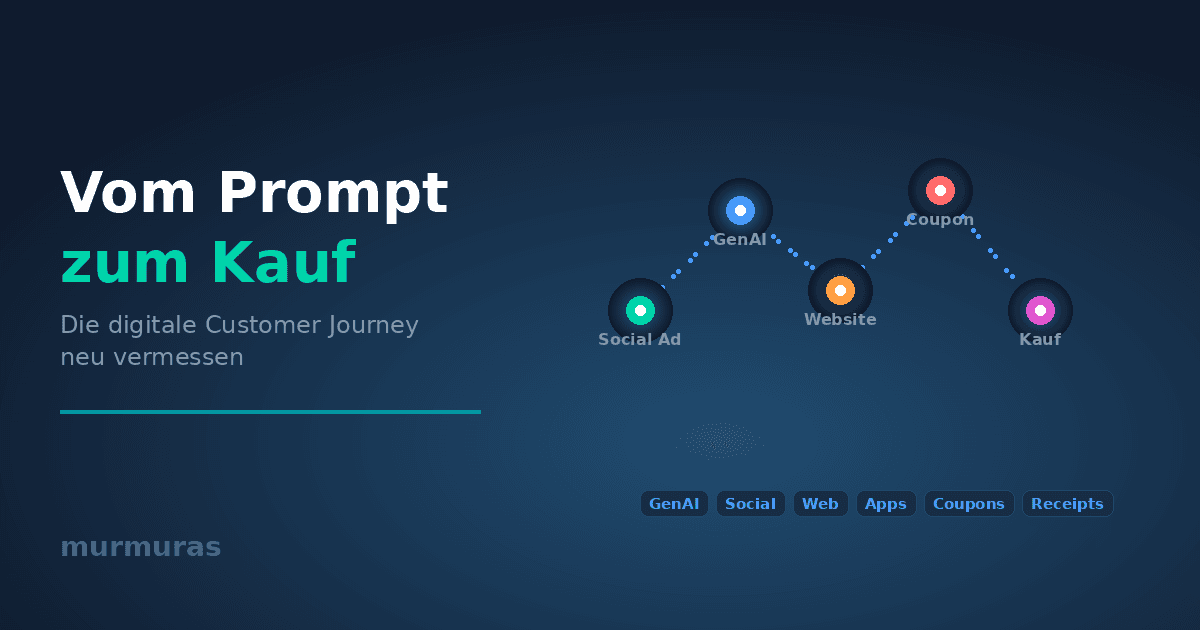
How Murmuras uses app data from 3,000 smartphone users to map the entire customer journey – from social media ads through AI chats to the receipt. A privacy-compliant smartphone panel makes visible what traditional tracking misses, and answers business questions along the entire journey.